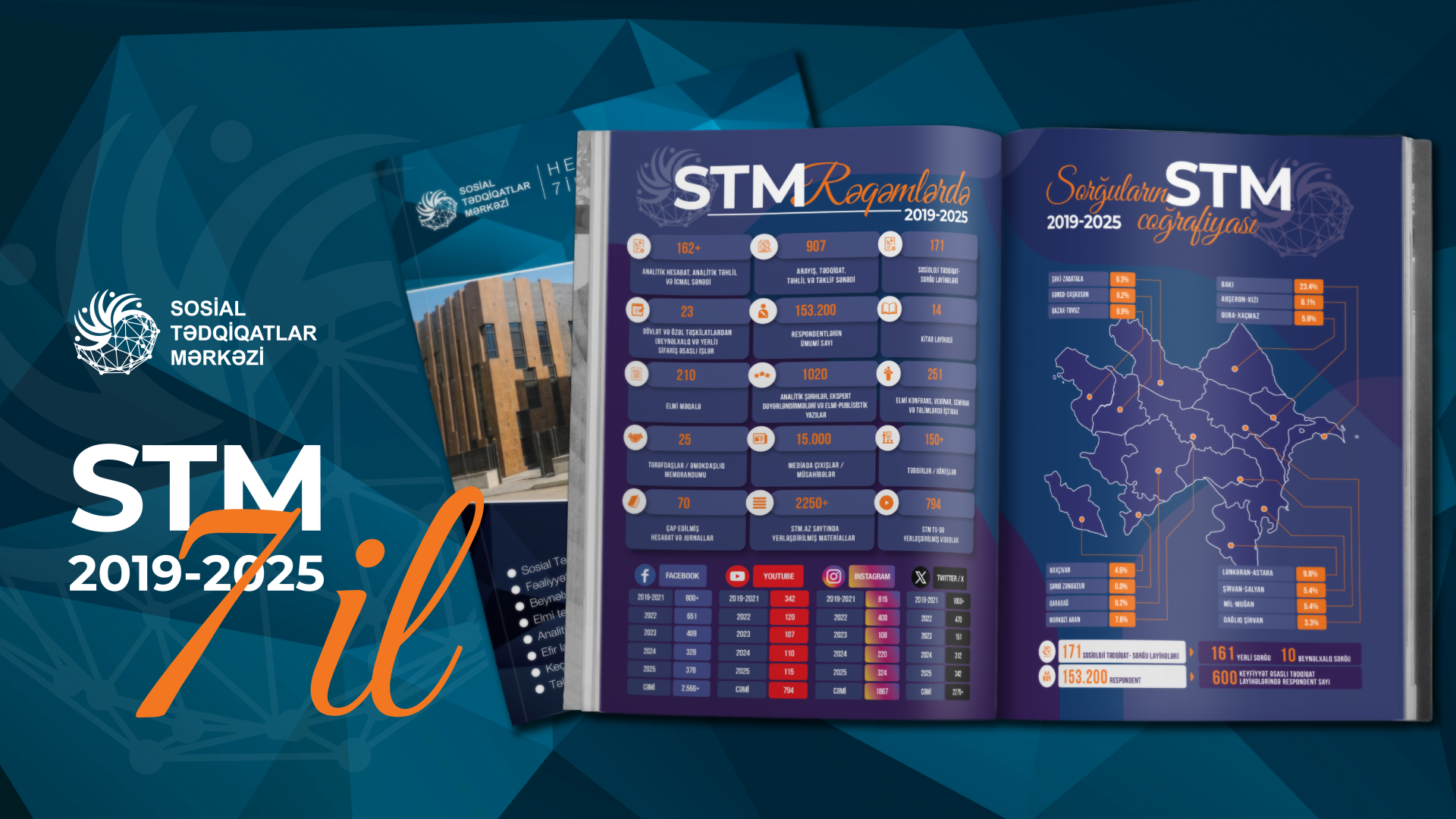
Social Research Center – 7 Years
 09.02.2026


 09.02.2026
In today’s environment, public relations have grown increasingly complex, while global transformations exert a stronger impact at the national level. As a result, evidence-based decision-making has become significantly more important. In this context, think tanks working in the field of social research have emerged as key institutional actors, contributing to the analysis of state–society relations, the study of public opinion, and the development of social policy.
Founded in response to these challenges, the Social Research Center (SRC) was established by Presidential Decree No. 525 on 8 February 2019. The Center aims to promote research-driven approaches in public administration, provide scientific analysis of socio-political and socio-economic processes, and support informed decision-making in state–society relations.
Over its seven years of operation (2019–2025), the SRC has established itself as one of the leading think tanks in multidisciplinary social science research. During this period, the Center has coordinated the design and execution of public opinion surveys, produced analytical reports, policy documents, position papers, and briefing materials, creating a reliable and continuous source of information for government institutions, relevant agencies, and the public. In doing so, SRC has played a key role in strengthening trust between the state and society, enhancing public engagement in governance, and examining the most pressing social dynamics.
The Center’s core mission is to conduct systematic analysis of social processes in the Republic of Azerbaijan, study public opinion, and provide scientific support for the state’s strategic decision-making. At the heart of its work is the goal of strengthening state–society relations, promoting social dialogue, and enhancing public trust.
Structured around contemporary social science methodologies, the Center’s research activities are guided by annual work plans aligned with the country’s current socio-political agenda. These plans enable multidimensional analysis of societal developments, identify the key drivers of social dynamics, and provide a scientific foundation for strategic decision-making.
Building on the scientific traditions of leading international think tanks and best research practices, the SRC conducts systematic and continuous studies of public opinion regarding government institutions, with a particular focus on the office of the President. These surveys represent one of the first comprehensive, regularly conducted research initiatives of their kind in Azerbaijan and are based on the widely recognized “Trust Index” methodology, which is extensively used in international research literature and global practice. This methodology provides highly reliable and comparable measures of public trust in and support for heads of state.
The primary objective of this research series is to capture real-time public attitudes toward the President’s performance, analyze the findings analytically, and track trends over time through quarterly monitoring. This approach allows for the scientific assessment of both short- and medium-term changes in public opinion.
Within the framework of the “President’s performance in public opinion – Trust Index” series, SRC has implemented a total of 15 research projects. Key areas of the President’s broad range of activities were identified based on their particular relevance in different periods and years, and these areas were evaluated through public opinion surveys, with the resulting data systematically organized and analyzed.
During the reporting period, the Social Research Center (SRC) participated in the implementation of state programs both as a primary and as a supporting executing body. Its institutional involvement went beyond simple execution, encompassing analytical support, the study of public opinion, and the development of evaluation mechanisms.
In line with the Action Plan of the “National Action Plan for 2022─2026 on strengthening the fight against corruption for 2022–2026,” approved by Presidential Decree No. 3199 on 4 April 2022, SRC was designated as the lead implementing body for the activity outlined in Subsection 4.9 under Priority Area 4, focused on improving public services and administrative mechanisms. Additionally, the Center served as a supporting implementing institution for Subsections 1.7, 2.4, 2.17, 5.1, 6.2, and 6.9 of the same Action Plan.
The activities outlined in the relevant sections of the Action Plan were carried out over the years, and the corresponding reports prepared by SRC were regularly submitted to the State Control Information System at the end of each year.
Under Presidential Decree No. 477, dated 11 February 2025, approving the “Action Plan for Declaring 2025 as the ‘Year of Constitution and Sovereignty’ in the Republic of Azerbaijan,” the Social Research Center was designated as one of the primary implementing institutions for Section 10 of the Plan. Within this framework, the Center was tasked with organizing scientific-practical conferences dedicated to state sovereignty with the participation of both domestic and international experts, conducting research projects, and producing scholarly works, legal commentaries, monographs, scientific articles, and thematic publications.
In line with this mandate, SRC carried out a series of significant scientific and organizational activities throughout 2025. Notably, on 5 November 2025, SRC, in collaboration with the Faculty of Law at Istanbul University (Türkiye), co-hosted an international scientific-practical conference under the “Year of Constitution and Sovereignty” initiative, titled “State Sovereignty and National Constitutions in the 21st Century: Global Challenges, Trends, and Prospects.” Materials presented during the conference were compiled into a 730-page scientific volume.
Additionally, in accordance with Section 2 of the same Action Plan, SRC published a special issue of its scientific journal Social Research, further contributing to the dissemination of research and analysis related to constitutional and sovereignty issues.
For SRC, collaboration with state institutions and partners extends beyond formal organizational relationships. It plays a critical role in applying the practical results of research in social, economic, and humanitarian fields, facilitating the exchange of analytical data, and implementing joint scientific-practical initiatives. To achieve this, the Center has established cooperation mechanisms based on active engagement with various central executive bodies, public legal entities, independent research institutes, and representatives of civil society.
During the reporting period, SRC established collaborative relationships with a wide range of government and public institutions, including the Ministry of Economy of the Republic of Azerbaijan, the Ministry of Labor and Social Protection of the Population, the Ministry of Science and Education, the Ministry of Ecology and Natural Resources, the State Committee for Family, Women and Children Affairs, the State Customs Committee, the State Migration Service, the Office of the Commissioner for Human Rights (Ombudsman) of Azerbaijan, the Central Bank of Azerbaijan, Azerbaijan Investment Holding, the Small and Medium Business Development Agency (KOBIA), the Mediation Council, and other state and public bodies. Through these partnerships, SRC implemented joint projects across various sectors.
SRC has also developed partnerships with professional and sectoral associations, including the Azerbaijan Insurers Association, the Azerbaijan Construction Manufacturers Association, the Chamber of Appraisers, and the Azerbaijan Trade Unions Confederation (ATUC). Through these collaborations, the Center has carried out joint research, analytical projects, and events. Within this framework, SRC has examined institutional challenges in the respective sectors, assessed the regulatory environment, and developed analytical approaches to evaluate and support sectoral development prospects.
The Center has also expanded its scientific and academic collaborations, partnering with ADA University, Azerbaijan State University of Economics, Baku State University, Azerbaijan State Pedagogical University, Baku Slavic University, Azerbaijan University, Baku Business University, as well as the Institute of Philosophy and Sociology of the Azerbaijan National Academy of Sciences. Through these joint research initiatives, expert discussions, analytical activities, and events, SRC has deepened both theoretical and empirical analyses of social processes and facilitated the integration of scientific knowledge into practical policymaking.
SRC has regarded its collaboration with civil society institutions and public organizations as a key avenue for expanding civic engagement, strengthening social dialogue, and ensuring that public opinion is more fully reflected in decision-making processes. This model of cooperation has contributed to building mutual trust between the state and society and promoting principles of transparent governance.
The sociological surveys conducted by SRC are designed to cover, depending on the study’s objectives and scope, the general population across the country, specific regions, as well as targeted groups. Data collection employs a variety of modern methods grounded in information technology, including CATI (Computer-Assisted Telephone Interviewing), CAPI (Computer-Assisted Personal Interviewing), CAWI (Computer-Assisted Web Interviewing), and PAPI (Paper-and-Pencil Interviewing).
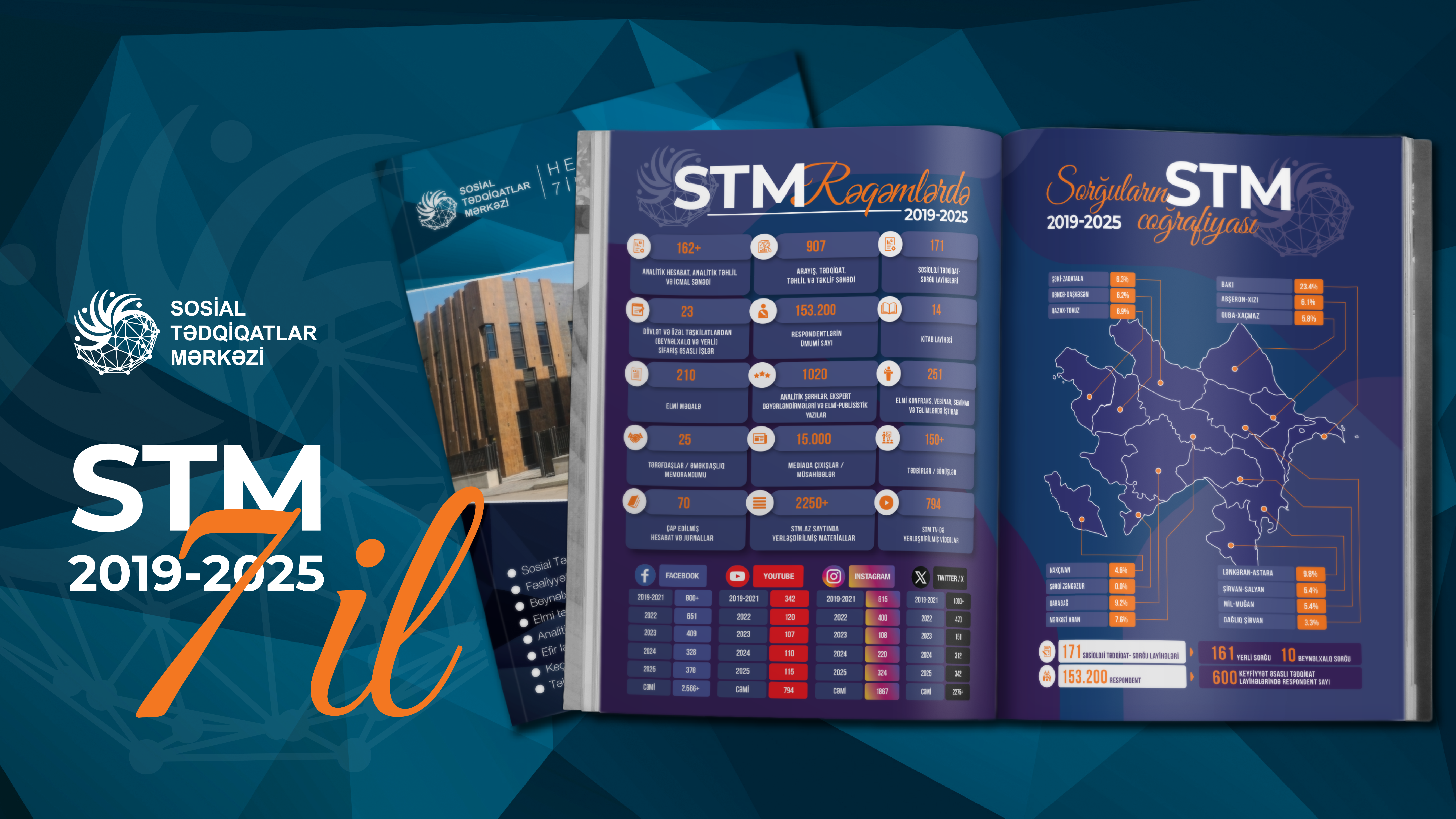
Between 2019 and 2026, SRC conducted 171 sociological survey projects, 161 domestic and 10 international, covering 14 economic regions of the country and involving a total of 153,200 respondents. In addition, nearly 600 participants were engaged in qualitative studies.
In international practice, one of the key strengths of think tanks lies in their ability to perform “knowledge translation”—transforming scientific insights into language and tools relevant for policy. SRC fulfills this role through analytical reports, briefings, and studies based on public opinion research. These documents aim to support the scientific enhancement of public administration, provide comprehensive understanding of social processes, and ensure that decision-making is informed by a rational evidence base.
SRC’s analytical outputs go beyond merely describing the current state; they are designed to identify the dynamics of social processes, their structural characteristics, and potential directions for future development. The Center’s analytical work is grounded in a systematic scientific approach, methodological rigor, and results-oriented evaluation. As such, the documents produced serve as significant resources both for scientific analysis and for practical management purposes. Between 2019 and 2026, SRC staff prepared over 160 analytical reports and more than 900 briefings, analyses, and policy recommendation documents.
During the reporting period, five issues of the journal Social Research, which was established in 2019 by SRC and is managed by an international editorial board, were published.
Books, scholarly and scientific‑journalistic articles, thematic collections, and analytical bulletins published by SRC form an integral part of the Center’s intellectual output. These publications play a key role in organizing the results of research in the social sciences, disseminating scientific knowledge, and enriching public discourse. Over its seven years of activity, SRC has completed 14 book projects, published more than 200 articles in domestic and international academic journals, and released over 1,000 analyses and expert commentaries across media platforms.
SRC has identified international collaboration as one of the priority directions of its institutional development strategy. The Center’s international engagement aims to enhance the quality of its research, conduct comparative and transnational studies, develop analytical perspectives on global challenges, and establish SRC’s presence within the international scientific community. Within this framework, SRC actively participates in think tank diplomacy, ensuring that Azerbaijan’s positions on regional and global issues are presented on a scientific basis across international analytical platforms. The Center has established cooperation with several prominent international and regional organizations, elevating these relationships to the level of institutional partnerships. Among its key partners are the United Nations High Commissioner for Refugees (UNHCR), the United Nations Development Programme (UNDP), the United Nations Population Fund (UNFPA), UN Women, the Council of Europe, the European Union Delegation, the World Bank, and BP Azerbaijan.
SRC has developed an extensive network of collaborations with leading think tanks, universities, and research institutions across various countries. This network includes the Turkish Academy, Türkiye’s SETA Foundation, the Turkish Maarif Foundation, the Marmara Group Foundation for Strategic and Social Research, Ankara University’s Asia-Pacific Studies Center, Hacı Bayram Veli University, Institute of Gallipoli Campaign, Uskudar and Hacettepe Universities, the Sonar Survey and Research Center, the Divan Research and Education Association, the Chinese Academy of Social Sciences, the Library of the First President of Kazakhstan (Elbasy), Qatar’s Ministry of Environment and Climate Change, the Qatar National Human Rights Committee, L. N. Gumilyov Eurasian National University and Astana IT University, Turkish Respiratory Research Association (TÜSAD), and the UK’s National Centre for Social Research.
One of the main priorities of SRC’s international collaboration is the implementation of joint research projects. In this context, the “Turkic Barometer” initiatives conducted in partnership with the International Turkic Academy are particularly significant. The research project titled “Turkic Barometer 2024: Current Approaches to Education and Scientific Cooperation in Turkic States” aimed to strengthen sectoral integration among Turkic-speaking countries. Within this project, SRC carried out extensive sociological surveys among teachers in schools and higher education institutions across Azerbaijan and conducted in-depth interviews with education experts. The findings were presented in English and Turkish at an international conference held in Baku, organized jointly with the International Turkic Academy.
Since 2023, SRC has represented Azerbaijan in the international research team of the Turkic Barometer project under the Organization of Turkic States. This representation continues in the 2026 edition of the project, “Turk Barometer 2026 – Artificial Intelligence and Public Opinion in Turkic States.”
SRC, in partnership with the European Union and the Council of Europe, conducted a nationwide sociological research project titled “Cybercrime and Cybersecurity Barometer in the Azerbaijan.” Implemented under the EU4Digital initiative, the project aimed to enhance cyber resilience, strengthen the capacity of law enforcement agencies, and raise public awareness.
SRC organized a dedicated conference to present the findings of the Cybercrime and Cybersecurity Barometer in Azerbaijan project. The event highlighted that while a significant portion of public services in Azerbaijan has been digitized, there has also been a noticeable rise in targeted religious-ideological and other propaganda activities aimed at youth in the virtual space. The conference emphasized recent developments in the country’s cybersecurity landscape and the importance of utilizing national solutions. Discussions also focused on exchanging ideas regarding the deployment of national solutions in critical information infrastructures and the management of emerging cyber risks.
Participation in international conferences and forums is a key component of SRC’s strategy for global scientific integration. SRC staff have represented the Center and delivered presentations at events such as the World Congress of Philosophy (Rome, Italy), the annual ESOMAR Congress (Prague, Czech Republic), the Global Baku Forums, the international conference “Artificial Intelligence and Human Rights: Opportunities, Risks, and Perspectives for a Better Future” (Doha, Qatar), the 2025 Global South Media and Think Tank Forum (Kunming, China), events held under COP29, as well as various other international scientific and practical conferences.
SRC has maintained its membership in ESOMAR, one of the world’s leading international platforms for sociological research, with staff actively participating in the platform’s global discussions and events. At the same time, the Center has been listed in the OTT Think Tanks international platform catalog, which has significantly contributed to SRC’s recognition within the global analytical community.
To strengthen the international integration of its scholarly publications, SRC became a member of the Publishers International Linking Association (Crossref). This membership plays a crucial role in enhancing the global indexing of the Center’s research outputs and increasing their citation potential.
Discussions have been held between SRC and the global research indexing platform “Elsevier Digital Commons” regarding the placement of scholarly publications and opportunities for institutional collaboration.
Public relations and communication activities play a crucial role in achieving the Center’s strategic goals and ensuring that its research outputs reach a broad audience. SRC’s communication strategy focuses on presenting scientific knowledge to society, disseminating research findings through media channels, and conveying information about state and institutional initiatives in a transparent and effective manner.
SRC staff actively engage on both domestic and international platforms, giving interviews to television, radio, and print media, as well as providing analytical commentary on social, economic, and political issues. During the reporting period, SRC experts delivered over 15,000 media appearances, interviews, and analytical contributions. Through these activities, they not only presented the Center’s own research findings but also offered expert analyses on national and regional contexts, supporting the evidence-based development of social and state policies.
The projects implemented by SRC serve to foster public discussion, bring social topics into open platforms, and facilitate the public’s engagement with scientific knowledge. These initiatives act as a key bridge for dialogue between civil society representatives, state institutions, and academic experts. Open debates and panel discussions constitute a core component of the Center’s communication and public engagement strategy. Among SRC’s initiatives “Real Tədqiqat” (Real TV), Deportasiyaya uğrayan irsin izi ilə” (Western Azerbaijan TV), “Arxa plan” (Fuyuzat TV), “Siyasi baxış” (Iki Sahil TV), and “Təhsilsiz” (in collaboration with the AzEdu portal) hold particular significance.
The English-language project Global Bridges, developed with the participation of international experts, further showcases the Center’s capacity for global communication. Through initiatives like this, the public engages in interactive dialogue, scientific topics are made more accessible, and expert analyses are widely disseminated.
STM’s official website, stm.az, has been active since September 2019. The platform serves to communicate the Center’s daily activities to the public, showcase research and survey reports, present scientific and analytical findings, and provide comprehensive information about the Board of Directors and team. It also functions as an institutional information resource, making STM’s research documents, survey results, and databases accessible to readers.
During the reporting period, over 2,250 materials were published on stm.az, highlighting the platform’s depth and richness as both a scientific and information-analytical resource.
The STM TV platform serves as a core component of the Center’s online media activities, aimed at strengthening public engagement and delivering scientific and analytical information to a broad audience. It functions both as a visual communication channel and as an interactive scientific-analytical platform. During the reporting period, 794 videos were uploaded to STM TV, covering a wide range of topics. The programs and videos featured on the channel are notable not only for their topical relevance but also for providing analytical insights that inform the public about social, political, and economic processes. The platform also conducts on-the-spot street surveys, offering valuable data for studying and analyzing public opinion.
Through its social media platforms, the Center not only disseminates research findings, public opinion surveys, and analytical reports to a wide audience but also creates opportunities for interactive discussions. During the reporting period, the STM Facebook page featured over 2,500 posts, while the Instagram account shared more than 1,860 visual and informational materials. On X, over 1,960 posts were published, covering current news, analytical commentary, and global thematic discussions.
Within its collaboration with higher education institutions across the country, STM organizes research internships and training programs for students. These initiatives are designed to reinforce students’ theoretical knowledge with practical skills, teach research methodologies in the social sciences, and develop analytical thinking abilities.
Through these internships and training programs, students gain hands-on experience in designing and conducting sociological surveys, collecting and analyzing data, drafting analytical reports, studying public opinion, and applying modern information technologies in the research process. The programs also support young researchers’ integration into the academic environment, foster adherence to scientific ethics, and help cultivate essential research skills for their future professional careers.
STM considers this collaboration a key priority, using it to strengthen university–research center connections and to promote the sustained development of the country’s scientific potential.
Thus, marking its seventh anniversary, STM’s strategic vision positions the Center as a leading actor within the national context and a trusted partner on regional and international platforms. The Center’s strategic goals for its next phase of development focus on enhancing research quality, strengthening institutional resilience, and expanding analytical impact. Within this framework, priority areas include deepening applied and comparative research, systematically producing policy-oriented analytical outputs, and maintaining continuous intellectual engagement with state decision-making processes.