
Transatlantic Relations at a Turning Point: Insights from John Sitilides on Europe, Ukraine, and Global Security
 17.02.2026


 17.02.2026
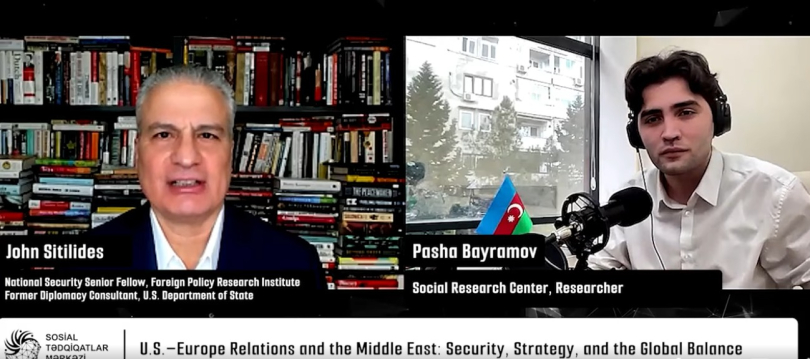
In a recent episode of Global Bridges, a podcast produced by the Social Research Center of Azerbaijan, key questions surrounding transatlantic relations, European security, and emerging global tensions were explored through a conversation with John Sitilides, a Washington-based geopolitical strategist and foreign policy expert. The discussion offered a wide-ranging assessment of how the international system is evolving under the pressure of great-power competition, the war in Ukraine, and instability in the Middle East.
Sitilides, who leads a strategic consulting firm and previously served as a diplomacy consultant to the U.S. Department of State, framed current developments not as a sudden rupture, but as the culmination of long-term structural shifts that have been unfolding for nearly two decades.
The End of an Exceptional Era in International Relations
One of the central themes of the discussion was the idea that the post–Cold War period represented an exception rather than a permanent model for global order. According to Sitilides, the assumption that globalization, economic interdependence, and rules-based cooperation would indefinitely prevent major conflicts underestimated the enduring reality of power politics.
He pointed to pivotal moments such as Russia’s warnings in the late 2000s regarding NATO enlargement, the first invasion of Ukraine in 2014, and the full-scale war that began in 2022 as evidence that unresolved security dilemmas were bound to resurface. Similar dynamics, he argued, can be observed in East Asia, where China’s growing assertiveness has reshaped regional and global strategic calculations.
From this perspective, today’s turbulence is less a collapse of order than a reversion to historical norms in which major powers compete for influence and security guarantees become central once again.
Europe’s Strategic Dilemma and Economic Decline
A significant portion of the conversation focused on Europe’s evolving position within the transatlantic partnership. Sitilides argued that for years, successive U.S. administrations encouraged European allies to assume greater responsibility for their own security, reduce strategic dependencies, and invest more seriously in defense capabilities.
In his assessment, Europe’s heavy reliance on external security guarantees, combined with energy dependence and regulatory overreach, left the continent vulnerable at a moment of renewed geopolitical confrontation. The consequences, he suggested, are visible not only in security terms but also in economic performance. While the European Union and the United States once stood on roughly equal economic footing, the gap between them has widened considerably over the past decade.
This divergence, Sitilides noted, has forced difficult questions onto the European agenda: why innovation has slowed, why strategic confidence has eroded, and whether Europe is prepared to act as a leading power rather than a reactive one in the 21st century.
Ukraine and the Transformation of NATO Expectations
The war in Ukraine has become a catalyst for rethinking Europe’s defense posture. Sitilides emphasized that while the United States continues to play a central role in NATO, Washington increasingly expects European allies to contribute more decisively to their own security.
Recent commitments by NATO members to increase defense spending were presented as evidence that the alliance is undergoing a structural adjustment. The United States, he argued, remains the ultimate guarantor through its nuclear deterrent, but conventional defense, infrastructure, and long-term resilience are areas where Europe is now under pressure to lead.
Importantly, Sitilides stressed that Ukraine’s position outside NATO underscores a fundamental distinction between legal obligations and political choices. Support for Kyiv, while substantial, reflects strategic calculation rather than treaty-bound necessity.
Middle Eastern Tensions and Strategic Uncertainty
Turning to the Middle East, the conversation addressed the broader implications of rising tensions surrounding Iran’s military capabilities and regional posture. Sitilides outlined a scenario in which Washington faces increasingly complex decisions shaped by nuclear proliferation risks, regional stability, and the safety of U.S. forces stationed across the Middle East.
Rather than focusing on rhetoric, he highlighted the strategic uncertainty surrounding any escalation: questions of deterrence, regional spillover effects, and the absence of clear post-crisis outcomes. He also noted that internal diversity within Iran complicates assumptions about political stability in the event of sudden change, raising concerns about unintended consequences for the wider region.
Implications for Transatlantic Unity
A key concern raised during the discussion was how a potential crisis in the Middle East could affect transatlantic cohesion. Sitilides argued that coordination, communication, and trust between Washington and European capitals would be decisive factors. Past experiences, particularly migration waves triggered by regional conflicts, have demonstrated how developments beyond Europe’s borders can rapidly destabilize internal politics within the EU.
In this context, the degree to which European allies are consulted and involved in strategic decision-making could shape not only diplomatic unity but also public trust within allied societies.
A More Demanding Strategic Environment
The conversation concluded on a sober note. Sitilides suggested that the international system is entering a phase where strategic ambiguity, competition, and risk management will dominate policymaking. For Europe and the United States alike, the challenge will be to adapt institutions, alliances, and expectations to a world where stability can no longer be taken for granted.
For audiences in Azerbaijan and beyond, the discussion underscored how regional conflicts, global power shifts, and alliance politics are deeply interconnected. As Sitilides emphasized, decisions taken in Washington, Brussels, or the Middle East increasingly carry consequences far beyond their immediate geographic scope.
Pasha Bayramov
SRC, Leading Advisor